The Big Green Salad
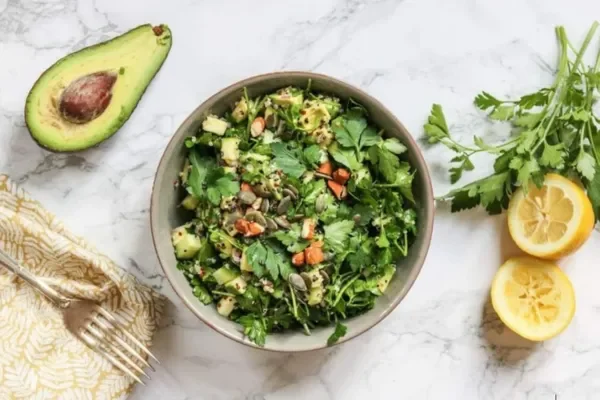
There are some recipes that quietly become part of your everyday routine, not because they are particularly elaborate or impressive, but because they are easy, delicious and make you feel good after eating them. The Big Green Salad is one of those recipes. It’s fresh and colourful, takes very little time to put together and is substantial enough to work as a proper lunch rather than simply a bowl of leaves.
As I’ve moved through my forties and into my fifties, this is increasingly how I want to eat. I’m less interested in complicated recipes or rigid ideas about what a healthy meal should look like, and much more interested in simple food that gives my body what it needs. I want plenty of vegetables, enough protein, healthy fats, fibre and ingredients that support steady energy, while still enjoying what is on my plate. Most importantly, I want meals that are realistic enough to make on an ordinary weekday when I have plenty of other things to do.
That’s exactly what this salad is about. Fresh parsley, cucumber and zucchini create the green base, quinoa gives it a little more substance, avocado brings creaminess and healthy fats, and red onion adds a lovely sharpness. A simple combination of lemon and extra virgin olive oil brings everything together, while a generous scattering of nuts and seeds adds crunch and makes the whole bowl more satisfying.
It’s uncomplicated food, but there is a lot of nourishment happening in one very simple meal.
A Salad that Actually Feels Like Lunch.
I think we’ve all encountered the kind of salad that looks healthy but leaves you wondering what else you can eat half an hour later. A few lettuce leaves, cucumber and tomato may make a perfectly good side dish, but if salad is going to be lunch, it needs to do considerably more than that.
For me, a good lunch needs to be satisfying enough to carry me comfortably through the afternoon. That means including a combination of vegetables, fibre, healthy fats, carbohydrates and protein rather than simply trying to make the meal as light as possible. The Big Green Salad has been created with that in mind. The quinoa, avocado, nuts and seeds give the vegetables more substance, while the different textures make the salad genuinely enjoyable to eat.
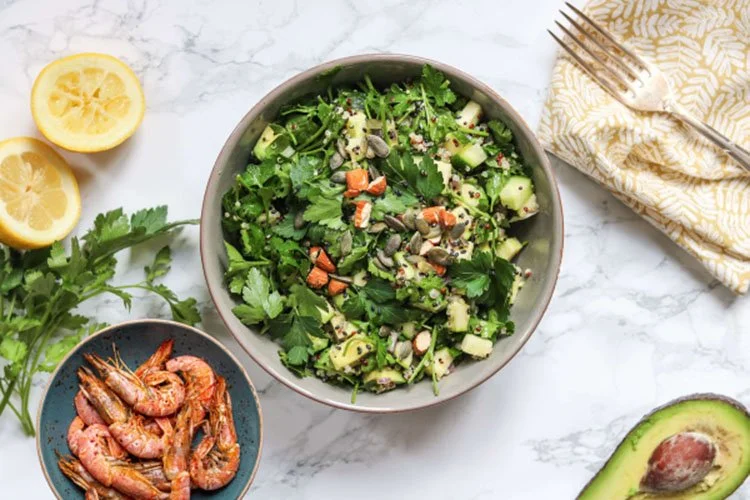
If you need something more substantial, it’s also incredibly easy to add a good source of protein. Grilled chicken, salmon, boiled eggs, chickpeas, lentils or tofu all work beautifully. Instead of thinking of the recipe as something that has to be followed exactly, think of it as a nourishing base you can build upon depending on your appetite and what your body needs that day.
That flexibility is one of the reasons I come back to meals like this so often. Healthy eating becomes much easier when we have a few simple foundations rather than feeling as though we need to invent an entirely new lunch every day.
Why I’m More interested in Adding Than Taking Away.
For so many years, women have been taught to think about healthy eating in terms of what we should remove. We’ve been encouraged to eat less, choose smaller portions, cut carbohydrates, avoid fats and continually look for ways to make our meals lighter. By the time we reach our forties and fifties, many of us have spent decades absorbing the message that eating well means taking something away.
These days, I find it much more useful to ask what I can add.
Could this meal use another vegetable? Is there enough protein? Could I add some healthy fats? Would a handful of herbs, nuts or seeds give me a little more nutritional variety? Is there enough food here to leave me genuinely satisfied?
That small shift changes the way a meal comes together. Instead of stripping food back until there is very little left, we begin building a plate that actually nourishes us. The Big Green Salad is a lovely example because almost every ingredient has been added for a reason, yet the finished recipe remains incredibly simple.
This becomes particularly relevant in midlife. Our nutritional needs don’t disappear simply because our bodies are changing. Protein becomes increasingly important for maintaining muscle, fibre remains important for digestive health, healthy fats have an important place in a balanced diet, and eating a varied range of plant foods provides vitamins, minerals and other beneficial plant compounds. Rather than responding to changes in our bodies by continually eating less, it makes sense to become more thoughtful about what the food we do eat is giving us.
Plenty of Plants Without Making it Complicated.
One of the easiest things we can do for our everyday nutrition is simply eat a greater variety of plants. That doesn’t mean you need to start counting vegetables or turning your weekly shop into another wellness challenge. It can be as simple as adding an extra handful of greens to lunch, scattering herbs over dinner, putting berries on breakfast or keeping nuts and seeds in the pantry to add to meals.
The Big Green Salad brings several different plant foods together without requiring much effort. Parsley is used generously rather than as a garnish, while cucumber and zucchini provide freshness and crunch. Avocado gives the salad its creamy texture, red onion adds flavour, quinoa provides another plant ingredient, and the nuts and seeds finish everything with texture and substance.
There is also plenty of room to add more. Baby spinach, rocket, asparagus, peas, broccoli, radishes or fresh herbs can all find their way into the bowl. In warmer weather I love keeping it crisp and fresh, while in cooler months you could add roasted broccoli, cauliflower, pumpkin or another seasonal vegetable.
The goal isn’t to create a nutritionally perfect salad. It’s simply to make it easier to put a generous variety of real food on your plate.
Fibre and Your Gut.
Fibre is one of those nutritional basics that can easily get lost amongst all the more exciting conversations about wellness, but it deserves our attention. It contributes to normal digestive function, helps with satiety and supports the gut microbiome, which is the community of microorganisms living within our digestive system.
Vegetables, fruit, wholegrains, legumes, nuts and seeds can all contribute fibre, which is another reason I prefer looking at variety across the whole week rather than relying on one particular ingredient. A meal such as The Big Green Salad naturally brings several of those foods together.
It’s also important to remember that digestive health is individual. If you have a sensitive gut, suddenly eating enormous quantities of raw vegetables may not make you feel wonderful simply because they are nutritious. You might prefer lightly cooked zucchini, a smaller amount of raw onion or a mixture of cooked and fresh vegetables. You can adapt the recipe according to what feels good for your body rather than forcing yourself to eat something because you think you should.
That is an important part of everyday wellness for me. Nourishment should support your body, not become another set of rules you have to follow.
Protein Matters in Midlife.
One thing I pay much more attention to now is protein. As we age, maintaining muscle becomes increasingly important for strength, mobility and healthy ageing, and adequate dietary protein plays an important role alongside resistance exercise and regular movement.
While quinoa, nuts and seeds contribute some protein to this salad, I would often add another protein source if I were eating it as my main lunch. A piece of grilled chicken or salmon is probably the easiest option, but boiled eggs, chickpeas, lentils or tofu are equally good depending on what you enjoy.
I also think it helps to stop thinking of protein as something that belongs mainly at dinner. Spreading protein-containing foods throughout the day gives us more opportunities to include it, and lunch is an easy place to do that. If you already have some cooked chicken, boiled eggs or lentils in the fridge, turning this salad into a more substantial meal takes almost no additional effort.
And that is really what gentle structure around food looks like. You’re not spending Sunday preparing twenty identical containers of food or following an elaborate meal plan. You’re simply making a few useful things available so that nourishing yourself during the week requires less thought.
Healthy Fats Make Everything More Satisfying.
Avocado, extra virgin olive oil, nuts and seeds all bring healthy fats to this salad, but they also make it taste considerably better. The avocado adds creaminess, the olive oil softens and carries the flavours of the lemon and vegetables, and the nuts and seeds provide that lovely crunch that makes every mouthful a little different.
Fat is also important for the absorption of fat-soluble vitamins, and including some fat in a meal can contribute to satiety. This is another reason I don’t believe a good salad should simply be a collection of raw vegetables with the smallest possible amount of dressing.
I want my lunch to taste good. I want it to be satisfying. And I want to get up from the table feeling as though I have actually eaten a meal. That might sound obvious, but after decades of diet culture telling women that less is somehow always better, it is worth saying.
The Big Green Salad Recipe
Serves 2 people | Prep time 10 minutes | No cooking required if using pre-cooked quinoa
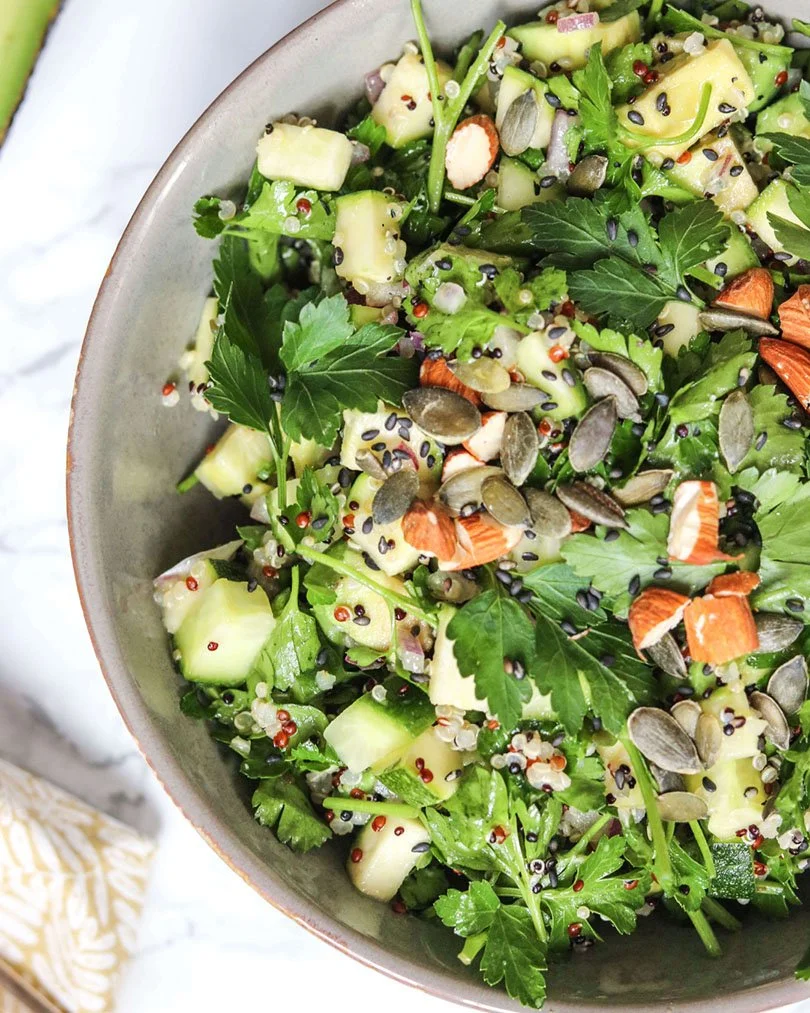
Ingredients
30 g fresh parsley, roughly chopped
50 g cooked quinoa
1 avocado, peeled, stone removed and cubed
½ cucumber, cubed
½ zucchini, cubed
1 small red onion, finely diced
Juice of 1 lemon
1 teaspoon extra virgin olive oil
Sea salt and freshly ground black pepper, to taste
For garnish:
30 g mixed seeds and nuts, roughly choppped
METHOD.
Place the parsley, cooked quinoa, avocado, cucumber, zucchini and red onion into a large bowl. Drizzle over the lemon juice and extra virgin olive oil, season with sea salt and freshly ground black pepper, then gently toss everything together until well combined.
Divide the salad between two bowls and finish with a generous scattering of mixed nuts and seeds. Serve immediately as a lighter lunch, or add grilled chicken, salmon, eggs, tofu, chickpeas or lentils if you would like to make it a more substantial meal.
Make Healthy Eating Easier Before You Need It.
One of the biggest lessons I’ve learnt about eating well consistently is that the best time to make a nourishing choice easier is before you are tired and hungry.
At 1pm on a busy day, most of us are not interested in cooking quinoa, washing herbs and thinking about how much protein we’ve eaten. We want lunch. Preferably now.
A tiny amount of preparation changes that completely. Cook some quinoa when you’re making dinner and keep a portion for lunch. Wash your vegetables when you bring them home. Keep nuts and seeds somewhere you can see them. If you’re cooking chicken or salmon for dinner, make an extra portion.
Then this salad stops being a recipe you have to prepare and becomes something you can assemble in ten minutes.
This is the kind of gentle structure I find far more sustainable than an elaborate meal-prepping routine. You don’t need every meal mapped out for the week. You simply need enough good food available that putting together something nourishing becomes the easiest option.
Make It Your Own.
The recipe is deliberately simple because I want you to be able to adapt it according to what you already have.
If there is no quinoa, use brown rice or lentils. If parsley isn’t your favourite, use baby spinach or rocket as the main green. Walnuts, almonds, pumpkin seeds and sunflower seeds all work beautifully. You can crumble over feta, add berries for a little sweetness or throw in leftover roasted vegetables from dinner.
You can also change the salad with the seasons. Fresh peas, asparagus and radishes would be lovely in spring. Tomatoes, cucumber and herbs work beautifully through summer. When the weather becomes cooler, roasted pumpkin, sweet potato, broccoli or cauliflower can make it feel warmer and more substantial.
This kind of flexibility is what makes a recipe useful in real life. You don't need exactly half a zucchini sitting in your fridge because the recipe told you to use one. If you have more cucumber, use more cucumber. If there is a handful of spinach that needs eating, add it. If you have leftover chicken, put that on top.
Use the recipe as a starting point and allow your fridge, your appetite and the season to do the rest.
A Simple Formula For a Better Lunch.
If you struggle with knowing what to make for lunch, it can help to stop thinking in terms of recipes and start thinking in terms of a simple formula. Begin with vegetables and greens, add a source of protein, include some healthy fat, add a nourishing carbohydrate if you want one, then finish with something that gives the meal flavour and texture.
The Big Green Salad follows exactly that pattern. Once you become familiar with it, you can create dozens of different lunches without needing a recipe at all.
That is the kind of food confidence I want us to have as we get older. Not memorising rules or constantly wondering whether something is “good” or “bad”, but understanding the foundations well enough that feeding ourselves becomes simpler.
Some days that might look like a beautiful bowl filled with vegetables, quinoa and grilled salmon. Other days it might be eggs on toast with avocado and a handful of greens. Both can be nourishing meals.
It is the pattern of what we do most of the time that matters.
Everyday Nourishment Should Fit into Everyday life.
There is already enough to navigate in our forties, fifties and beyond. Changing hormones, disrupted sleep, fluctuating energy, digestive changes, maintaining muscle and simply keeping up with everything life asks of us can make looking after ourselves feel like another job.
I don't think we need wellness to become one more thing we are failing to do perfectly.
What we need are small things that make everyday life feel a little better. A breakfast that keeps us going through the morning. A walk that clears our head. A kitchen stocked with a few useful ingredients. A lunch that takes ten minutes to make but actually gives our body something worthwhile.
The Big Green Salad fits into that kind of life. It isn't complicated and it doesn't promise anything extraordinary. It's simply a fresh, generous bowl of real food that brings together many of the things I want us to eat more often: vegetables, plants, fibre, healthy fats and enough substance to feel satisfied.
Add some protein when you need it, change the vegetables with the seasons and make it work with whatever is already in your fridge. There is no need for perfection and no need to make healthy eating harder than it needs to be.
Sometimes feeling better begins with something as ordinary as making yourself a proper lunch.
And this is a very good one to have in your repertoire.