Baked Salmon with Roasted Winter Vegetables

If I could persuade you to add just one thing to your week for the sake of how you feel, it might be this: oily fish, twice a week. It's one of the most genuinely useful, well-established things you can do to settle that heavy, achy, inflamed feeling — and unlike so much wellness advice, it asks very little of you in return. No supplements, no powders, no protocol. Just dinner, a couple of times a week.
And dinner doesn't come much easier than this. Salmon and a tray of vegetables, roasted together, on the table in about half an hour, with barely anything to wash up afterwards. It's the sort of meal that makes eating well feel like less effort rather than more — which, in my experience, is the only kind of healthy eating that actually lasts.
WHY OILY FISH MATTERS SO MUCH.
Salmon — along with sardines, mackerel and trout — is rich in omega-3 fatty acids, and this is where the real value lies. Omega-3s are among the most reliably anti-inflammatory things you can eat, genuinely well-studied and genuinely effective, and most of us simply don't get enough of them. Our modern way of eating tends to be heavy on the fats that nudge inflammation up and light on the ones that settle it down, and oily fish is the simplest way to tip that balance back.
There's a particular reason this matters for women in midlife and beyond. As our hormones shift through and after menopause, we lose some of the natural protection we had in earlier years, and inflammation tends to creep up. The everyday things that help — and omega-3s are near the top of the list — matter more now than they did at thirty. This isn't about chasing youth or fixing anything that's broken. It's about giving your body a bit more of what genuinely supports it through a real transition.
Two servings of oily fish a week is the general guide, and it's an easy one to hit. This traybake is one. A few pieces of smoked salmon on toast is another. It adds up faster than you'd think.
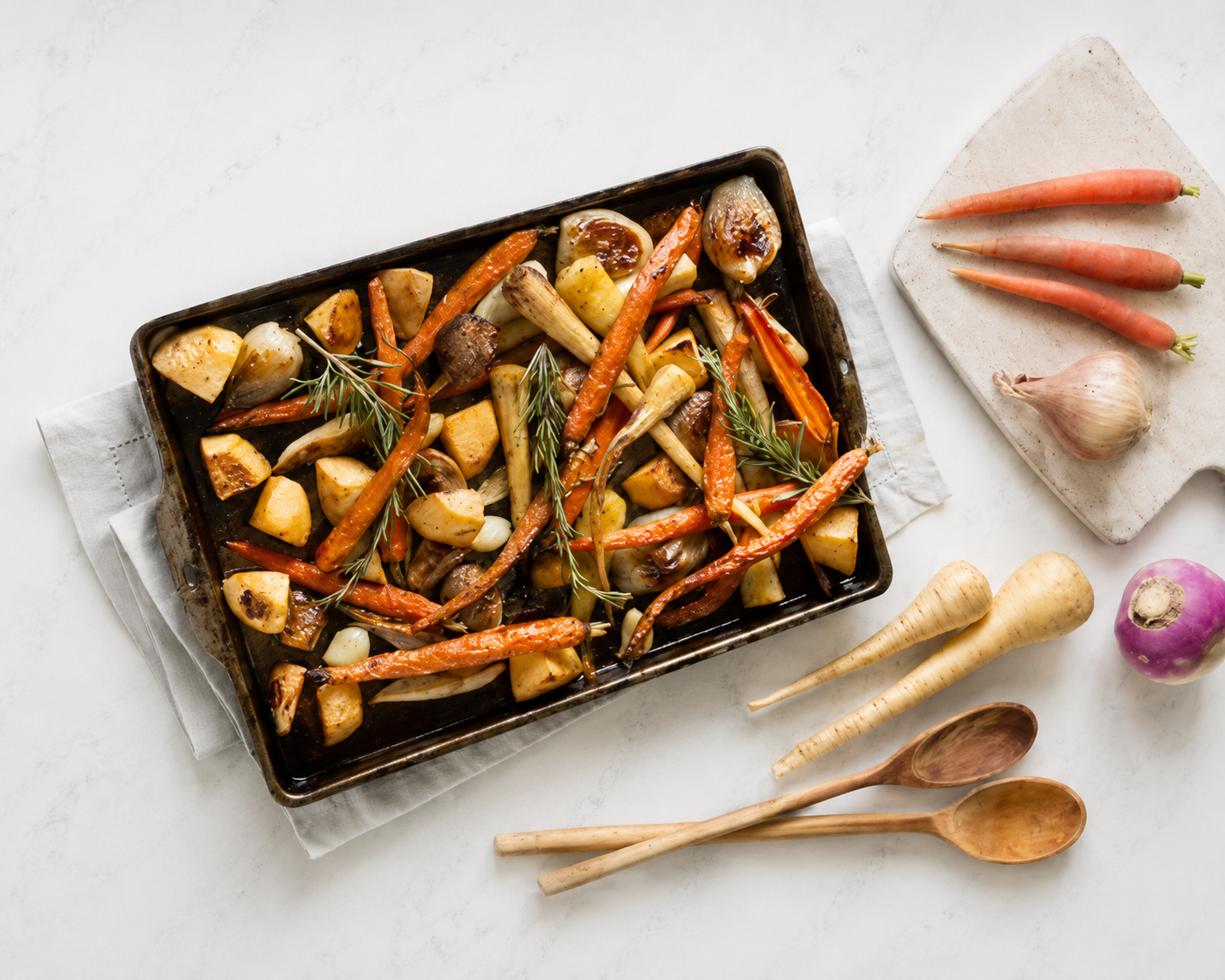
THE VEGETABLES ARE NOT A SIDE.
It would be easy to think of the vegetables here as merely the thing the salmon sits on. They're not. They're doing real work of their own.
Beetroot, carrots and red onion are all deeply, richly coloured — and that colour is the point. The pigments that make vegetables vivid are a good part of what makes them worth eating; they're the plant's own protective compounds, and they become yours when you eat them. As a general rule, the deeper and more varied the colours on your plate across a week, the better you're doing. A tray like this, all jewel tones and caramelised edges, is quietly ticking several boxes at once.
Roasting them does something lovely, too. The dry heat concentrates their sweetness and gives them those crisp, golden edges, which turns humble root vegetables into something you actually look forward to rather than dutifully eat. And roasting them in the same tray as the salmon means they take on a little of its flavour and the lemon and oil — no extra pans, no extra effort, more taste.
THE LEMON AND THE GOOD FATS.
A squeeze of lemon over the salmon before it goes in the oven, and another at the table, does more than you'd expect: it lifts the richness of the fish, brightens the sweet roasted vegetables, and pulls the whole plate together. Acidity is the finishing touch that so many home cooks forget, and it's the difference between a dinner that tastes flat and one that tastes complete.
And don't be shy with the olive oil. The good fats it brings aren't the enemy the low-fat years made them out to be — they help you absorb the fat-soluble goodness in both the fish and the vegetables, they keep you satisfied, and they make everything taste better. Virtue and pleasure pointing in the same direction, which is how I like a recipe to work.
A FEW NOTES BEFORE YOU COOK.
The vegetables need a head start, since roots take longer than fish — so give them their twenty minutes before the salmon goes in, and everything finishes together. Cut them a roughly even size so they cook at the same rate. Beetroot will stain everything a cheerful pink, which I consider a feature; if you'd rather it didn't, keep it to one corner of the tray.
Use whatever deep-coloured vegetables you have — sweet potato, parsnip, red capsicum and pumpkin all work beautifully alongside or instead of the ones here. The salmon is done when it flakes easily with a fork and has just turned opaque in the middle; a minute or two less rather than more keeps it moist. And if you're cooking for one, it scales down without any trouble — just keep an eye on the timing, as a smaller tray cooks a touch faster.
Comforting enough for a cold evening, light enough that you don't feel weighed down afterwards. One tray, minimal fuss, proper food that loves you back.
THE RECIPE.
Serves 2 · 35 minutes
Ingredients
2 salmon fillets
1 beetroot, peeled and diced
2 carrots, chopped
1 red onion, cut into wedges
½ lemon
Olive oil, salt and black pepper
A little fresh parsley
Method
Heat the oven to 200°C. Toss the beetroot, carrot and onion with olive oil, salt and pepper on a tray. Roast for 20 minutes.
Push the vegetables aside, sit the salmon on the tray, drizzle with olive oil and squeeze over the lemon.
Roast for another 12–15 minutes, until the salmon flakes easily and the vegetables are tender.
Scatter with parsley, add a final squeeze of lemon at the table, and serve.
This is one of four simple anti-inflammatory recipes I'm sharing this week — a breakfast, a lunch, a dinner and something sweet, all designed to leave you feeling a little lighter and brighter. If you'd like more like this, I send a free letter each week on eating and living well without the fuss. You can join it here.